



Is the AI Gold Rush Heading for a Cliff Edge? What Financial Leaders Are Saying About a Looming Bubble

The air crackles with excitement. From tech giants to fledgling startups, the promise of Artificial Intelligence is reshaping industries, sparking innovation, and, perhaps most notably, sending stock valuations soaring. We’re witnessing an unprecedented surge, a modern-day gold rush where every algorithm and breakthrough seems to add another zero to company balance sheets. But beneath the glittering surface of AI’s meteoric rise, a chorus of cautionary voices is growing louder, emanating from the very institutions that govern our global financial stability.
Leading financial institutions, including the formidable International Monetary Fund (IMF) and the venerable Bank of England, are not just observing this phenomenon; they are actively warning of a looming AI bubble. Their concerns are not abstract; they point to concrete indicators like sky-high valuations and rapidly escalating stock prices. Are we witnessing the dawn of a new era of productivity and prosperity, or are we hurtling towards an economic correction that could leave many investors bruised? Let’s delve into what these powerful voices are saying and what it might mean for the future.
The Warnings from the Top: IMF and Bank of England Sound the Alarm
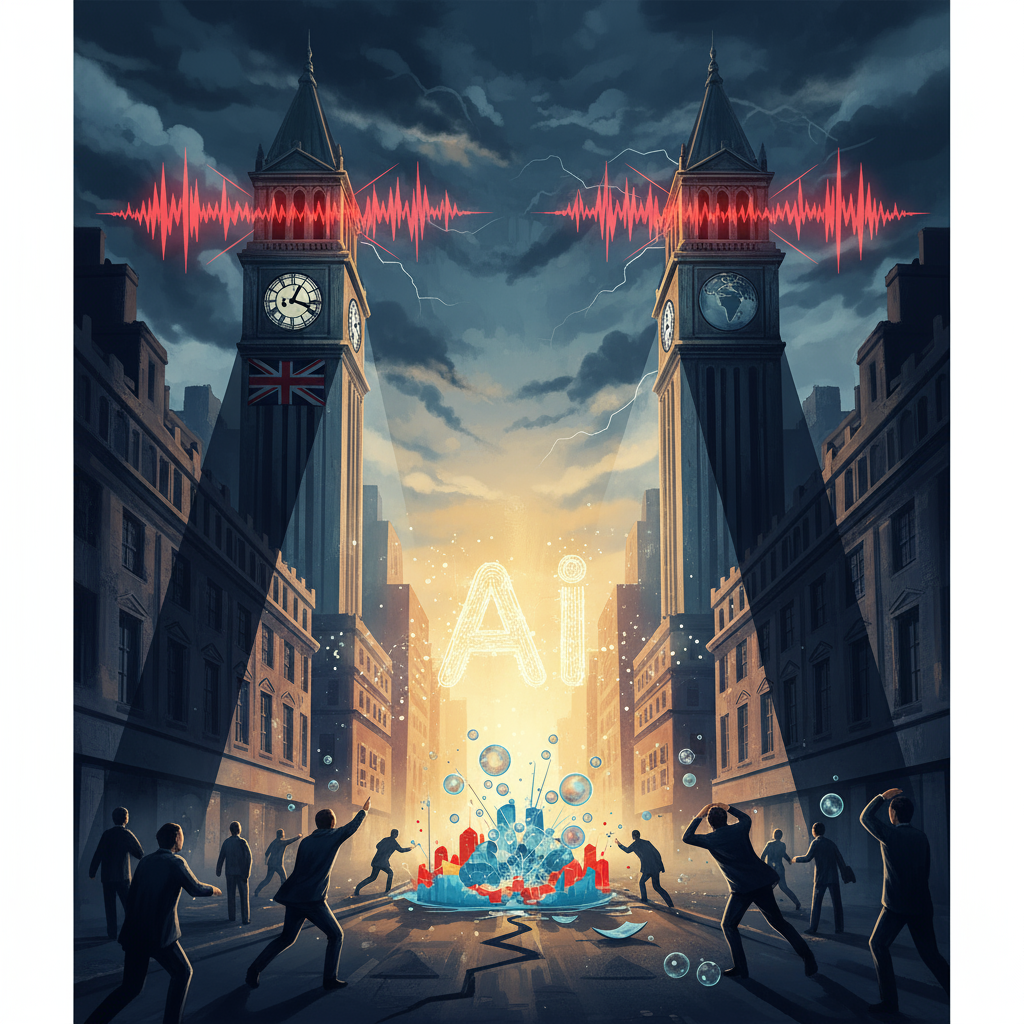
When institutions like the IMF and the Bank of England speak, the world listens. Their statements are not mere observations; they are often carefully calibrated signals of potential systemic risks. And right now, their focus is squarely on AI.
Kristalina Georgieva, the Managing Director of the IMF, recently delivered a sobering assessment at the Milken Institute in Washington DC. Her message was clear and stark: “uncertainty is the new normal and it is here to stay.” This isn’t just a philosophical musing; it’s a direct acknowledgment of the volatility and unpredictability inherent in our current economic landscape. She further emphasized the prevailing sentiment fueling market exuberance, noting that “fired up by optimism about the productivity-enhancing potential of AI, global equity prices are surging.” While optimism is generally a good thing for markets, unchecked optimism, particularly when disconnected from tangible underlying value, can be a recipe for trouble.
The Bank of England echoes these sentiments. While specific quotes from the Bank of England in the provided source are not detailed beyond their general warning, their inclusion alongside the IMF signifies a consensual concern among major financial regulators. Both institutions possess sophisticated analytical capabilities and global perspectives, making their shared apprehension particularly noteworthy. They’re not just seeing technological advancement; they’re seeing financial patterns that resemble past speculative manias.
The Anatomy of a Potential Bubble: Soaring Valuations and Unbridled Optimism
What exactly defines an “AI bubble,” and why are these institutions so worried? At its core, a bubble forms when asset prices become significantly disconnected from their intrinsic value. This detachment is often fueled by speculative fervor, herd mentality, and an optimistic narrative that overshadows fundamental analysis.
- Exorbitant Valuations: Companies with even a tangential connection to AI are experiencing valuation multiples unheard of in many other sectors. Investors are pouring capital into these firms, often betting on future potential rather than current profits or established market share. This can lead to a situation where a company’s stock price reflects years, or even decades, of projected growth, leaving little room for error or unforeseen challenges.
- Narrative-Driven Investment: The AI story is incredibly compelling. It promises to revolutionize healthcare, transportation, finance, and virtually every aspect of human life. This powerful narrative can sometimes overshadow critical due diligence, leading investors to buy into the “idea” of AI rather than scrutinizing individual company fundamentals, competitive landscapes, or realistic timelines for profitability.
- Ease of Access to Capital: With abundant liquidity in the markets and the allure of high returns, both public and private capital are readily flowing into AI ventures. This ease of funding can perpetuate unsustainable business models or accelerate growth without sufficient market validation, contributing to inflated valuations.
- Comparison to Past Bubbles: Financial history is replete with examples of bubbles – the dot-com bubble of the late 1990s, the housing bubble of the mid-2000s, and even earlier speculative manias like Tulip Mania. While each bubble has its unique characteristics, common threads include rapid price appreciation, widespread public enthusiasm, and eventually, a sharp correction when the reality fails to meet exaggerated expectations.
What Happens If the Bubble Bursts? Potential Ripple Effects
The term “bubble bursting” evokes images of immediate, widespread financial chaos. While this is a possibility, the impact of an AI bubble correction could manifest in several ways, with varying degrees of severity.
- Investor Losses: The most direct impact would be on investors who have poured significant capital into overvalued AI stocks. Retail investors, attracted by the promise of quick riches, are often among the hardest hit in such downturns. Pension funds and other institutional investors could also see substantial portfolio losses, affecting retirement savings for millions.
- Reduced Innovation Spending: A significant correction could lead to a contraction in funding for AI research and development. Companies, wary of another downturn, might cut back on ambitious projects, potentially slowing the pace of technological advancement, at least in the short to medium term.
- Economic Slowdown: In a worst-case scenario, a major AI market correction could trigger broader economic instability. If highly indebted companies fail, it could spill over into the banking sector, leading to tighter credit conditions and a general slowdown in economic activity. The “wealth effect” – where people feel richer due to rising asset prices and therefore spend more – would reverse, leading to decreased consumer spending.
- Impact on Emerging Technologies: While some AI applications are genuinely transformative, a bubble burst could unfairly tarnish the perception of the entire field, making it harder for even legitimate and well-founded AI companies to secure funding and market acceptance post-correction.
Buckle Up: Navigating the AI Landscape
Kristalina Georgieva’s concise advice to “buckle up” is perhaps the most salient takeaway for anyone navigating today’s financial markets. It’s a call for prudence, preparedness, and a recognition that even in times of exhilarating technological progress, economic fundamentals still matter.
For investors, this means exercising caution, conducting thorough due diligence, and avoiding the temptation to chase every rising stock. Diversification, a long-term investment horizon, and a clear understanding of risk tolerance are more crucial than ever. For policymakers and regulators, it necessitates vigilant monitoring of market trends, assessing potential systemic risks, and considering proactive measures to ensure financial stability.
The potential of AI to revolutionize our world remains undeniable and incredibly exciting. However, the financial enthusiasm surrounding it, as highlighted by the IMF and the Bank of England, warrants careful consideration. As we stand at this fascinating precipice of technological advancement, a healthy dose of skepticism, combined with strategic foresight, will be essential to harness AI’s true potential without succumbing to the pitfalls of speculative excess. Whether the “AI bubble” bursts or slowly deflates, understanding the risks is the first step toward building a resilient financial future.